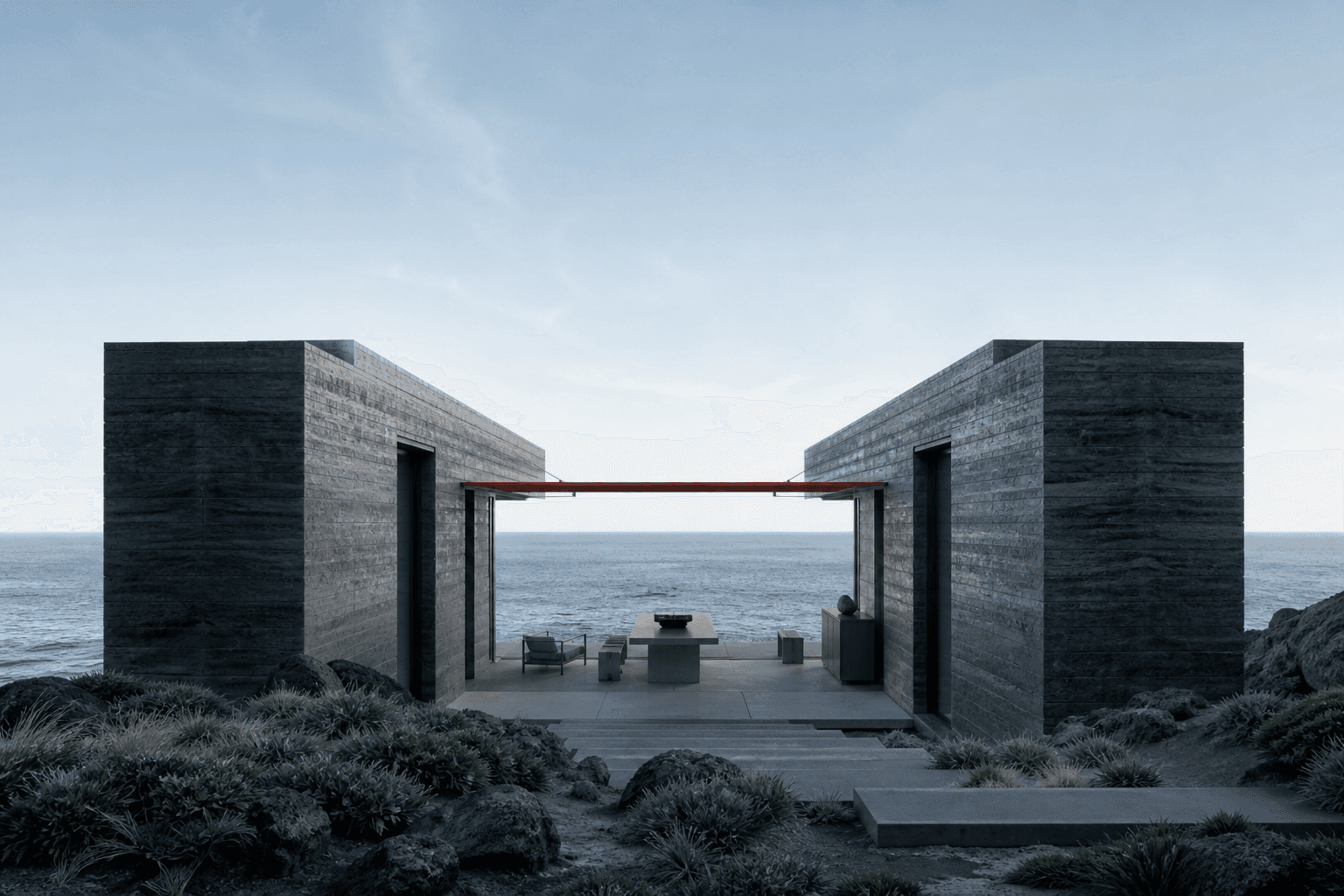
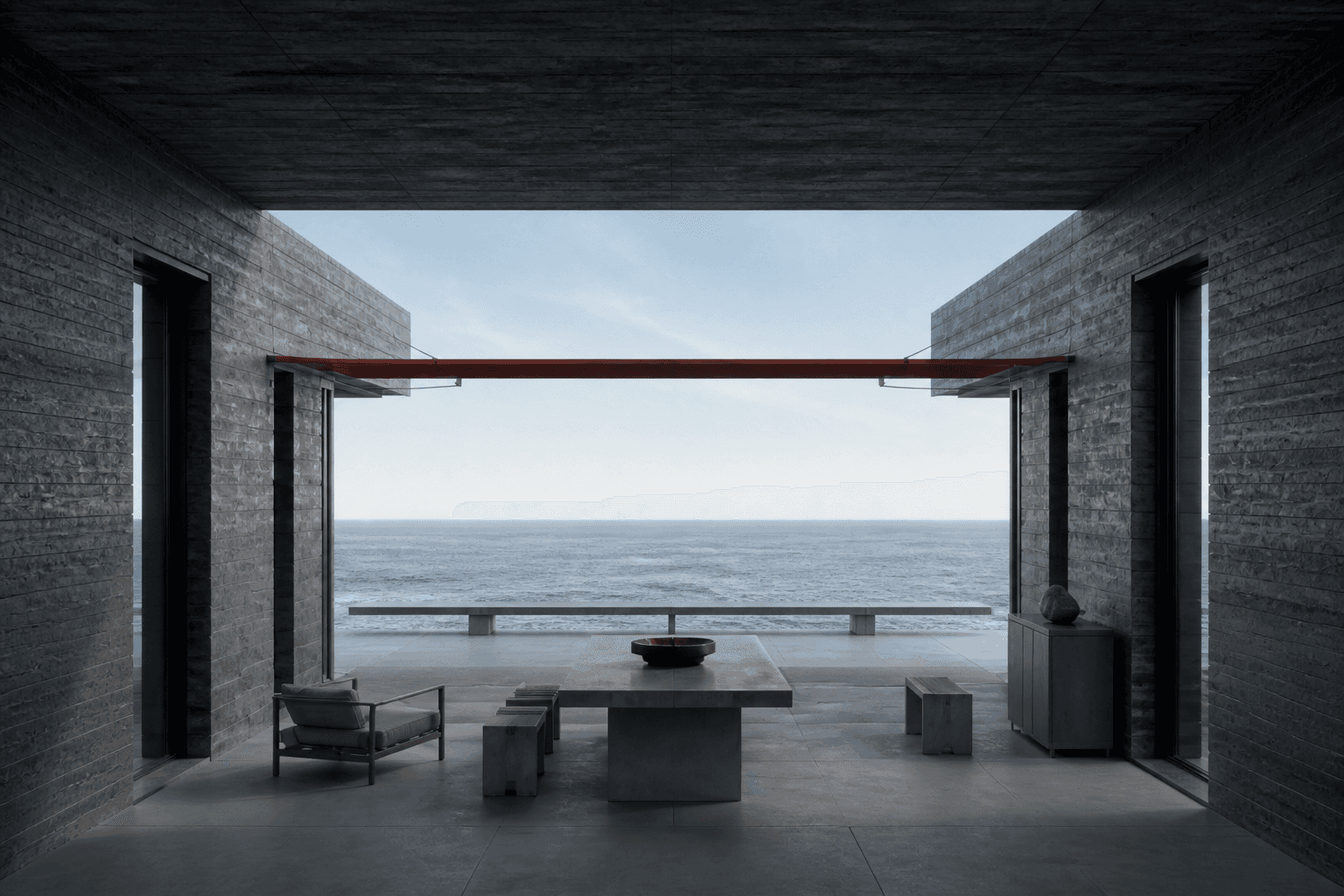
The view begins behind you
A horizon has the greatest force when arrival withholds it. The most memorable coastal and mountain houses begin with compression: a shaded court, a low passage, a turn against a solid wall. Only after the body has adjusted does the distant line appear. This sequence gives the landscape duration. It transforms a view from background information into an event that can be anticipated, crossed and remembered.
Architects often study the first reveal but overlook what happens immediately after it. A window seen while standing is different from the same opening experienced at a table or from a bed. Designing the horizon means setting several eye levels, calibrating the thickness of reveals and deciding which daily rituals deserve a long outlook and which benefit from enclosure.
Frames are stronger than glass walls
More glazing does not necessarily create more connection. An uninterrupted curtain wall can flatten distance and make the interior feel exposed. A deep opening, by contrast, gives the eye an edge and establishes scale. Side walls remove peripheral distraction; an overhang cuts glare; a low sill brings ground or water into the composition. The frame becomes a piece of architecture that edits rather than merely transmits.
The same principle can operate across a plan. A sequence of aligned openings can borrow one horizon for several rooms without making them identical. In a library it may appear as a narrow band above shelves; in a bath it can be a protected square; in a living room it may expand across an entire bay. Repetition creates orientation while variation preserves intimacy.
Protect what the house borrows
A borrowed horizon depends on land beyond the building. Long-term value therefore begins with view-corridor studies, planting strategy and an understanding of neighboring development rights. New trees should frame rather than slowly erase the intended outlook. Exterior lighting should remain low enough for darkness to survive. The architecture’s visual claim carries a stewardship obligation: if a house draws meaning from a larger landscape, its maintenance should help preserve that landscape’s legibility.
This is why the finest view houses rarely feel like observation decks. They include places where the horizon disappears, rooms that look into courts and paths that return attention to stone, bark or shadow at arm’s length. Distance gains meaning through contrast. A home becomes richer when it can hold both the immeasurable and the near.