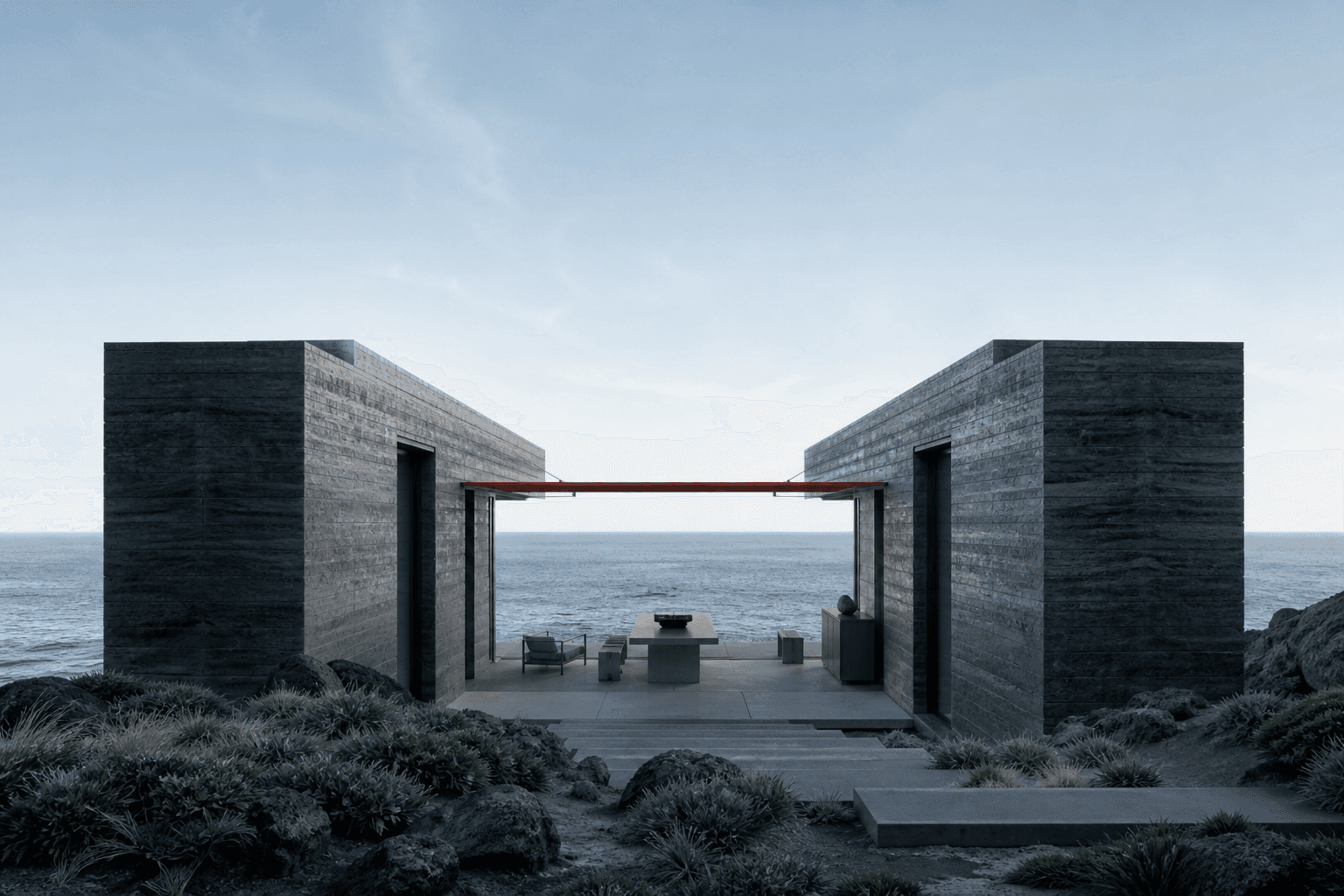
A material that edits light
Volcanic stone is often described through strength, yet its most useful architectural quality may be optical. Honed basalt holds a soft, almost matte reflection; rough lava catches light at thousands of small edges; pumice-colored aggregate turns a wall into a low-contrast field. These surfaces do not compete with art, furniture or a landscape. They give each of them a darker, steadier register against which to appear.
This restraint is particularly effective in rooms that receive strong sun. Where polished marble can create glare and visual movement, an open-pore basalt floor absorbs contrast and allows the eye to rest. The result is not austerity. Timber, linen, metal and skin all seem warmer beside a mineral surface whose color remains difficult to name.
Performance without display
Dense volcanic stones can contribute useful thermal mass, moderating temperature swings when they are placed inside a well-insulated envelope. In dry climates, dark stone floors release the day’s heat slowly after sunset. In cooler coastal houses, the same mass can work with low-temperature radiant systems. Porous varieties require careful sealing, but that porosity can also improve acoustic softness compared with harder, highly polished surfaces.
Specification matters more than the label on a sample. Extraction method, block size, resin, surface treatment and backing can change both the environmental cost and the way a material ages. A locally quarried stone with a modest finish may be more convincing than an exotic slab shipped across several borders. Ask fabricators to show weathered pieces and wet samples; volcanic stone reveals its real character through use, not in a showroom tray.
The value of an imperfect register
The strongest applications accept variation. Small pits, charcoal clouds and mineral inclusions become a record of formation rather than defects to be edited out. Repetition should be controlled at the level of module and joint, while the stone itself is allowed to remain irregular. That balance—precise architecture carrying materially uncertain surfaces—is why volcanic stone feels contemporary now. It offers permanence without polish and atmosphere without ornament.