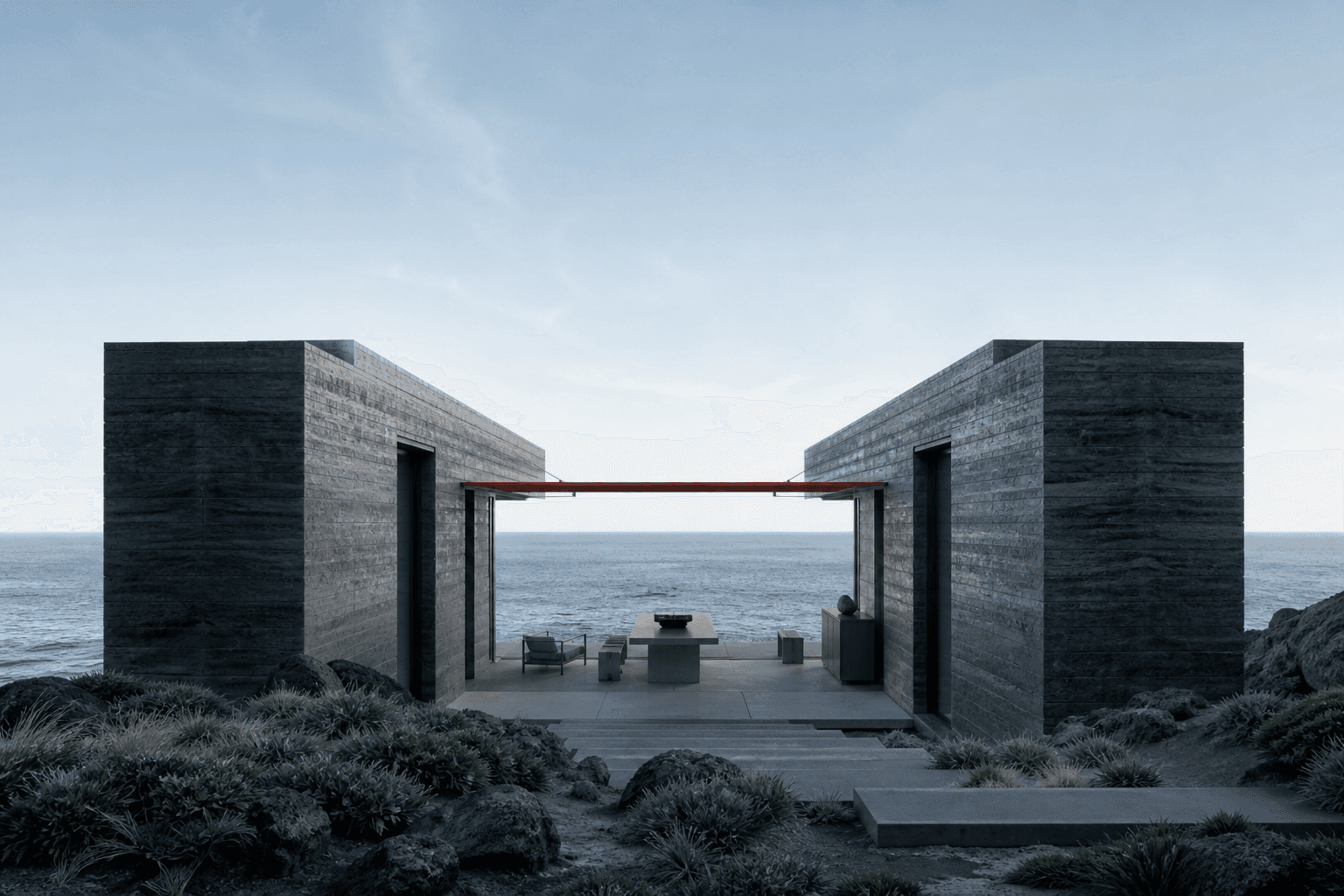
Begin with movement, not walls
Large-scale art changes the way a body crosses a room. Before assigning a work to a wall, map the approach: where it first enters peripheral vision, how close a visitor can stand and whether furniture interrupts the preferred distance. A long oblique view can reveal surface and depth more effectively than a frontal one. Circulation is therefore part of display, and the plan should protect several clear paths without making domestic life feel choreographed.
The white cube is an unhelpful default for a home. Art can hold its own beside timber, stone, books and the evidence of daily use, provided the surrounding register is edited. Fewer materials, consistent hardware and disciplined storage usually achieve more than uniformly white surfaces. The goal is not neutrality but a stable visual field in which art and life can coexist.
Daylight needs a plan
Natural light creates pleasure and risk in equal measure. UV exposure, heat and sharp daily fluctuations can damage works long before visible fading appears. External shading is more effective than relying only on internal blinds, while north light or reflected court light is easier to manage than direct western sun. Pair architectural control with calibrated artificial lighting so a room remains coherent when protective screens are closed.
Conservation decisions should be made with a specialist early enough to influence glass specification, humidity zoning and mechanical systems. Sensors can quietly record conditions, but they do not replace stable envelopes and sensible placement. Works on paper, textiles and photographs need particular care; sculpture may demand floor reinforcement, lifting routes or vibration isolation that cannot be improvised after completion.
Design for change
Collections evolve. Provide several wall dimensions, flexible power and lighting tracks, and at least one room capable of receiving work larger than anything currently owned. A discreet handling route from delivery point to display area prevents every installation from becoming an event. Good storage should be accessible, conditioned and documented rather than treated as a distant archive.
Most importantly, leave some walls empty. Rotation gives individual works time and attention, and absence prevents the residence from becoming a catalogue. A collection feels alive when relationships can be revised: a sculpture moved into morning light, a painting brought close to a dining table, an unfamiliar pairing tested for a season. Architecture should support that curiosity rather than freeze a single arrangement.