Treat darkness as material
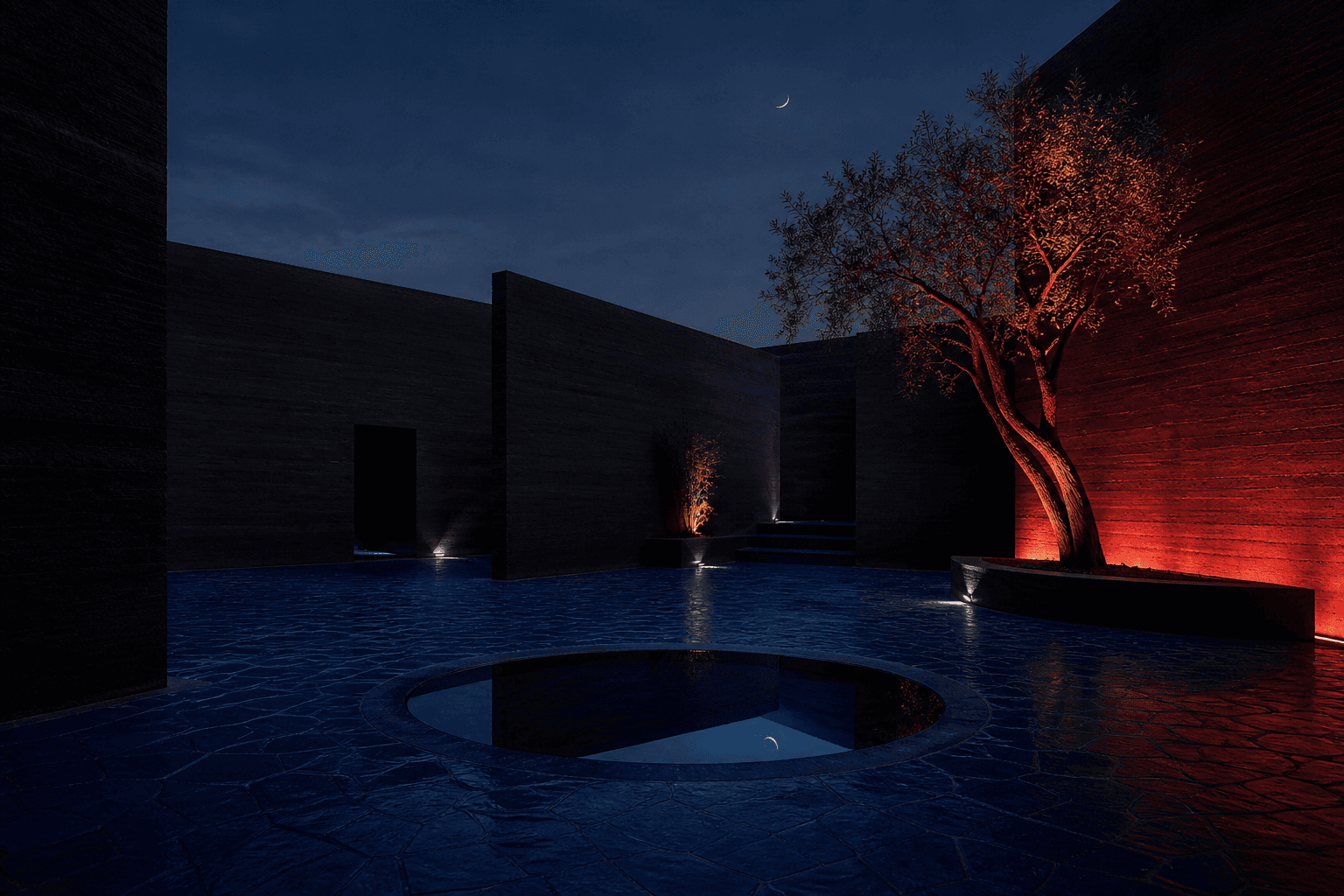
A courtyard at night should not be illuminated evenly. Uniform brightness removes depth, exposes every boundary and turns an outdoor room into a diagram. Begin instead with darkness, then add only what supports movement or attention: a low wash across one wall, a pool of light beneath a tree, a narrow line at a threshold. The eye connects these fragments and completes the space.
Fixtures are most convincing when their source disappears. Light can be reflected from plaster, caught in foliage or held below the surface of water. Warm color temperature usually allows stone and skin to remain natural, while glare control matters more than absolute output. From bedrooms and adjacent rooms, verify that no lamp becomes a bright object in the field of view.
Plant for the hours you inhabit
Night changes the hierarchy of a garden. Color retreats; silhouette, movement and fragrance become prominent. Pale bark, fine grasses and leaves with silver undersides respond to minimal light. Night-blooming jasmine, citrus and herbs close to seating contribute without requiring visual abundance. Planting should also shape airflow, allowing warm air to rise and cooler currents to move through lower openings.
Water is most effective when it remains quiet. A dark reflecting basin doubles a lit canopy and gives the courtyard a second depth. A small rill can mark circulation through sound alone. Pumps and spillways should be tuned so they do not dominate conversation, particularly in dense neighborhoods where the court is also an acoustic buffer.
Privacy without closure
Screens, deep arcades and planted thresholds can protect a courtyard without sealing it off. Perforated elements become especially useful after dark: they obscure direct views while allowing air and scattered light to pass. Their pattern should be tested at real scale because a screen that feels solid on a drawing may become transparent when the brighter space is behind it.
The successful night courtyard is not a stage for the building. It is a room of air with its own pace, capable of holding dinner, solitude or the few minutes between arriving home and going inside. Its luxury lies in calibration—the confidence to leave much unseen.